Football Betting for Beginners: Lesson 1 (Odds & Bankroll)
This is lesson 1 of our guide to football betting for beginners. However, before you think about tips, accumulators or "sure things", you need three basic skills. First, you must be able to read odds. Second, you need to turn those odds into a probability. Finally, you need a plan for your money, so one bad weekend never wipes you out. In this lesson, therefore, we cover all three with simple maths and real football examples.
Football Betting for Beginners: Start With the Right Mindset
First of all, betting is entertainment with real money at risk, not a way to earn a living. Indeed, even the best analysts lose many bets, because football is full of red cards, deflections and late goals. In fact, a good bet can lose and a bad bet can win on any given day. That is why we judge decisions over hundreds of bets, not over one weekend. In addition, emotions are your biggest enemy. For example, chasing losses with bigger stakes is the fastest way to empty your account. So, from day one, set a budget you can afford to lose and never go above it.
How to Read Betting Odds
To begin with, odds come in three main formats, but they all say the same thing. Decimal odds are the easiest and the most common in Europe, Africa and Asia. In practice, they show your total return for every 1 unit you stake, including the stake itself. For example, a £10 bet at 2.50 returns £25, which means £15 profit plus your £10 back.
On the other hand, fractional odds are popular in the UK. For instance, a price of 6/4 means you win £6 for every £4 staked, which is exactly the same as 2.50 in decimal. American odds, meanwhile, use plus and minus signs. A price of +150 means a £100 bet wins £150, while -200 means you must stake £200 to win £100. As a result, in decimal those prices are 2.50 and 1.50. For this reason, we use decimal odds throughout this guide and in all our previews.
Implied Probability: What the Odds Really Say
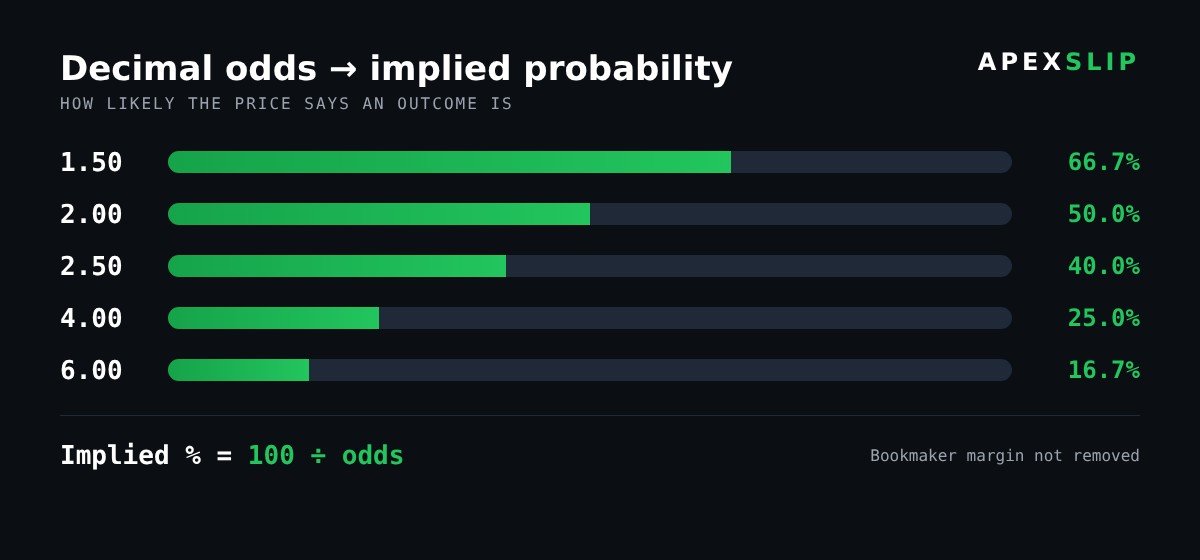
In fact, every price hides a probability. To find it, divide 100 by the decimal odds. Therefore, odds of 2.00 imply a 50% chance, odds of 2.50 imply 40% and odds of 4.00 imply 25%. Similarly, a heavy favourite at 1.50 is rated about a 66.7% chance by the bookmaker.
Moreover, this simple step changes how you look at every bet. Instead of asking "will this team win?", you start asking "is this team more likely to win than the price suggests?". Ultimately, that question is the heart of smart betting, and we come back to it below.
How Bookmakers Build in Their Margin
Next, if you add up the implied probabilities of every outcome in a market, the total is always above 100%. Basically, the extra part is the bookmaker's margin, also called the overround. For instance, imagine a match priced at Home 2.10, Draw 3.40 and Away 3.60. In that case, the implied probabilities are 47.6%, 29.4% and 27.8%, which add up to 104.8%. In other words, the bookmaker has built in a margin of almost 5%.
Similarly, two-way markets show the same thing. If over 2.5 goals and under 2.5 goals are both priced at 1.90, each side implies 52.6%. As a result, together they make 105.3%, even though only one can happen. Therefore, the lower the margin, the better the deal for you. For example, comparing prices across bookmakers is one of the easiest ways to improve your long-term results.
Value Betting: The Idea That Matters Most
Now, a value bet is one where the odds are bigger than they should be. Put simply, your estimate of the chance is higher than the implied probability. For instance, suppose a team is priced at 2.50, which implies 40%. After studying form, injuries and the matchup, you believe their real chance is closer to 45%. Consequently, that gap is value.
Better still, you can measure it with a quick formula: expected value equals your probability multiplied by the odds, minus 1. In this case, 0.45 × 2.50 − 1 = +0.125. In other words, you expect to gain about 12.5p for every £1 staked over the long run. However, if the real chance were only 35%, the same bet would be worth −12.5p per £1. Notably, famous clubs are often overbet by casual fans, so their prices can be too short. As a result, value is more often found away from the obvious names.
Bankroll Management: Protect Your Money
To start with, your bankroll is the money you set aside only for betting. Above all, it must be money you can afford to lose without affecting rent, bills or family. Once you have it, split it into units. In general, most experienced bettors stake 1% to 2% of their bankroll on a normal bet, and rarely more than 5% on any single selection.
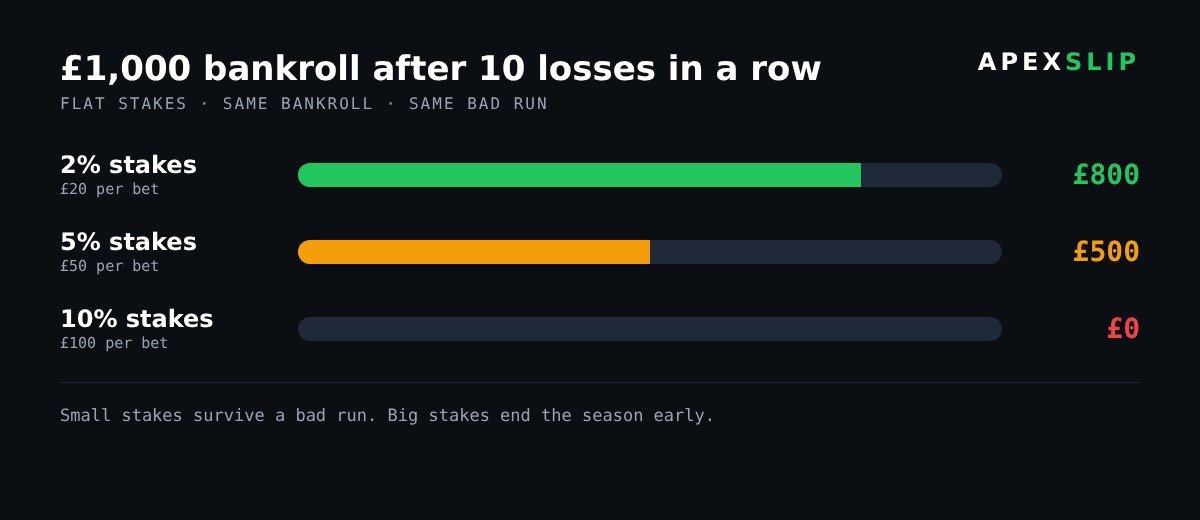
Here is why that matters, for example. Imagine a £1,000 bankroll and a run of 10 losing bets, which happens to every bettor sooner or later. At 2% stakes (£20 per bet), you still have £800. Raise the stake to 5%, and you are down to £500. With 10% stakes, however, the whole bankroll is gone. Clearly, the bad run is the same in all three cases, but only the small stakes keep you in the game.
Keep a simple record of every bet, too. Specifically, note the date, market, odds, stake and result. Over time, after 50 or 100 bets, your record will show which markets suit you and where you are losing money.
Where Beginners Should Start
First, start with simple markets that you understand fully. In particular, match result, double chance and draw no bet are good places to begin. Draw no bet, for example, returns your stake if the game ends level, which removes one of the three outcomes. You can see it in action in our Man City vs PSG prediction. Likewise, our Arsenal vs Lille prediction shows how an Asian handicap works on a real match. Besides, avoid long accumulators at the start. After all, every extra leg multiplies the bookmaker's margin, so a 6-fold slip is a poor deal even when it looks exciting.
Key Takeaways
To sum up, football betting for beginners comes down to three habits. In short, read odds as probabilities, look for prices that are bigger than they should be and protect your bankroll with small, steady stakes. In the next lesson, we will explain the most popular betting markets, from both teams to score to Asian handicaps. Meanwhile, browse our latest football predictions and see these ideas applied to real fixtures.
FAQ
What is the most important lesson for new bettors?
Bankroll management. Staking a small, fixed share of your betting money on each bet lets you survive the losing runs that every bettor faces.
How do I convert odds into probability?
Divide 100 by the decimal odds. For example, odds of 2.50 imply a 40% chance and odds of 4.00 imply a 25% chance.
How much should I stake on one bet?
Most experienced bettors stake 1% to 2% of their bankroll on a normal bet and rarely more than 5% on any single bet.
Can betting guarantee a profit?
No. Every bet carries risk, and even good bets lose often. Only bet with money you can afford to lose.
18+ only. Please gamble responsibly. If betting stops being fun, free and confidential support is available at BeGambleAware.